 Resource Balance Analysis
Main | What is RBA | Models | Software | Contact
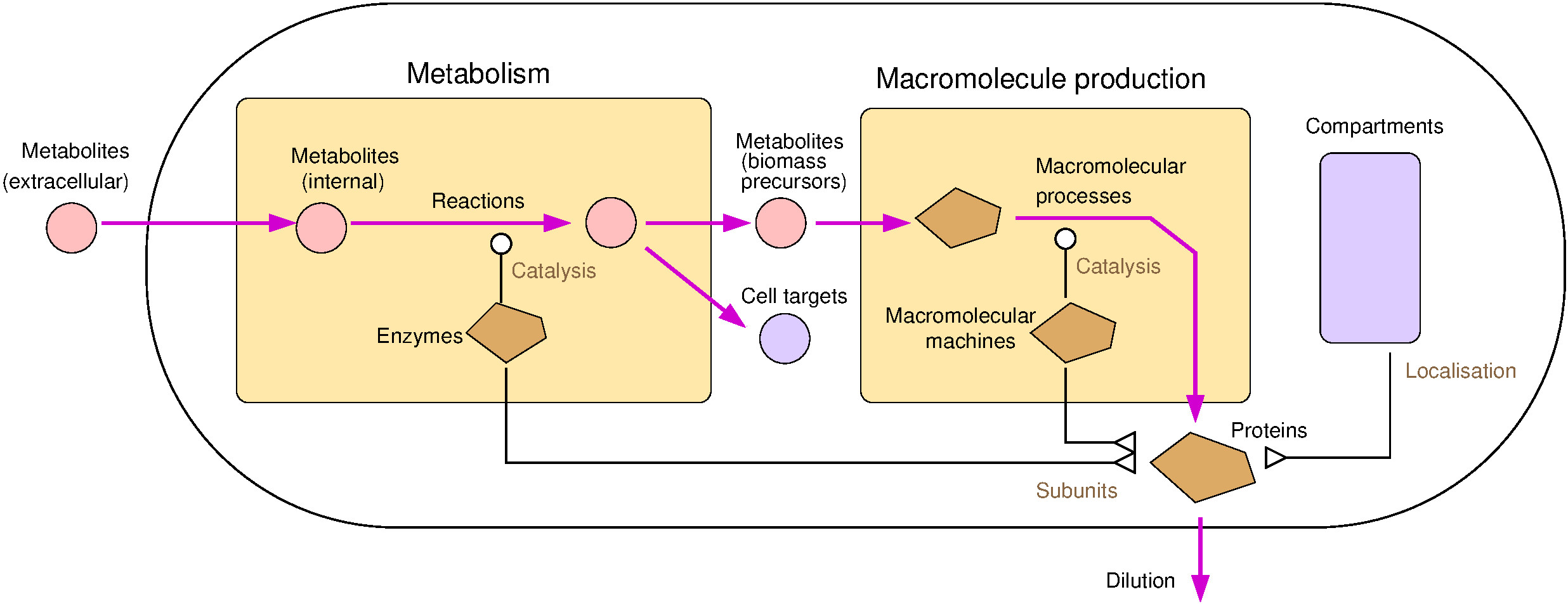
A cell in RBA: metabolism, production of macromolecules (by molecular machines such as ribosomes), and cell compartments.
Resource balance analysis (RBA) is a constraint-based framework for genome-scale models of cells. Starting from a metabolic network, an RBA model describes how a cell allocates its resources (enzymes, ribosomes and other molecular machines, and space in membranes and compartments) and predicts its maximal growth rate and macromolecular composition in a given environment. Models can be refined step by step by adding cellular processes such as transcription, translation, protein secretion, or chaperoning. The RBA framework was originally developed to describe bacteria growing in batch cultures and has since been extended to dynamical growth conditions, chemostat cultures, and eukaryotic organisms such as plants.
This website explains how to build and use RBA models and provides resources including models and Python software. If you use our RBA code for your research, please cite our articles Bulović et al. (2019) and Bodeit et al. (2026) (for RBApy) or Bodeit et al. (2023) (for RBAtools).
Start here: Learn about RBA | Browse models | Install RBA software